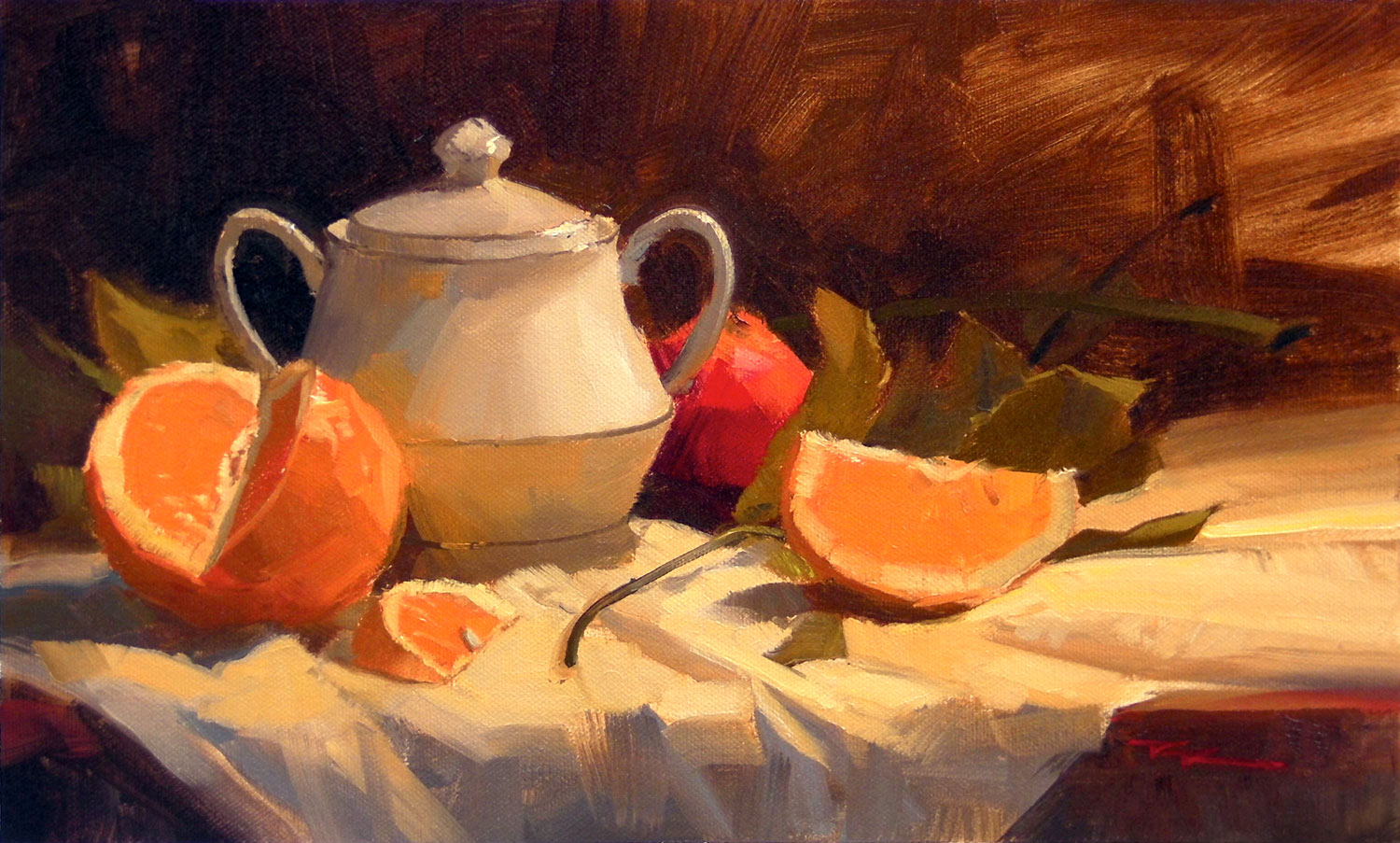
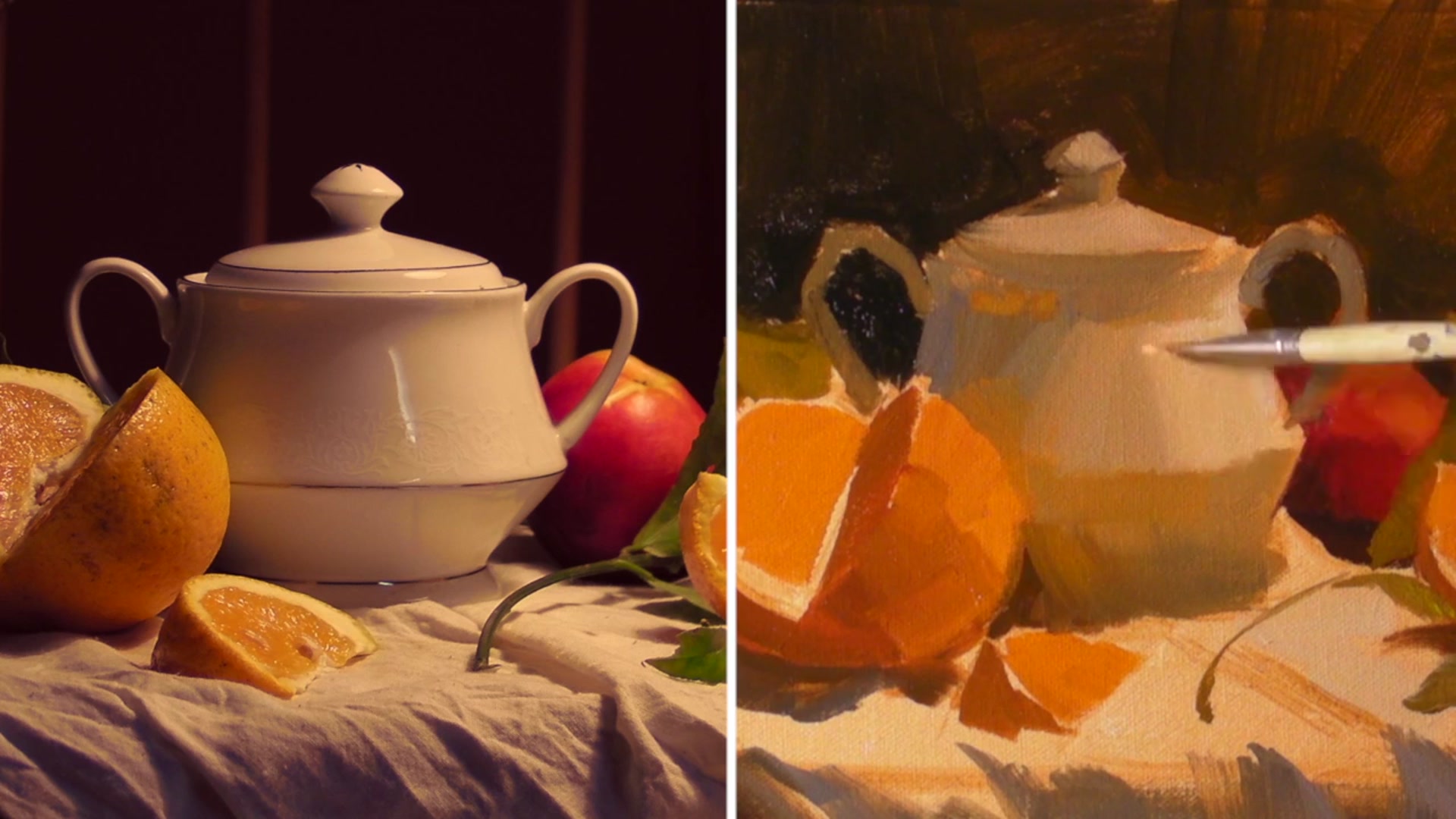
Welcome to Workshop 7, aptly named 'Oranges.' In this chapter, we dive deeper into the art of still life painting, focusing on the vibrant and inviting subject of oranges. While we've set aside the pear and grapes from our previous lesson, feel free to incorporate them if you wish. I've kept the white vessel in our composition, as it presents a wonderful opportunity to refine our skills in capturing those elusive subtle greys—something we all found challenging last time. To elevate the complexity and interest of our setup, I've added leaves, stems, and a white tablecloth, creating a more intricate scene to explore. This lesson is all about capturing the luminous quality of the oranges, particularly the way light interacts with their vivid flesh. By positioning the light source strategically, we aim to achieve a stained glass window effect, enhancing the high-chroma colors and bringing a sense of life and vibrancy to our painting. Join me as we tackle this rewarding subject, honing our skills and deepening our appreciation for the beauty of still life art.
This guide accompanies the full video lesson. The lesson includes the complete narrated video, the printable PDF chapter, and personalised critique support.
Use a standard incandescent 100 watt light bulb to illuminate your scene. This light source emits a very yellow light, which influences the colors in your painting.
Observe Light and Shadow
Notice how the light affects the colors in your painting. The shadows are not just gray; they are warm and light due to the yellow light source. This contributes to the glowing effect in your painting.
Pro tipIncorporate the color of the light source into the light areas of your painting to enhance the glowing effect.
In this lesson on painting oranges, you begin by focusing on capturing the vibrant hues and lighting effects that make the fruit appear luminous and vivid. Position your light source strategically to create a stained glass effect, enhancing the high-chroma colors of the orange flesh. As you progress, pay attention to the composition and how light interacts with the objects, using a white tablecloth to reflect light and create dynamic color interactions.
As you build your painting, consider the progression and unity of colors by incorporating elements like a red nectarine to create a spectrum from red to orange to yellow. Prepare your palette with a mid-grey and a selection of primary and secondary colors, and use a value scale to maintain accurate values. Establish the structure of your still life by setting limits with drawing and color, and pay close attention to the interplay of light and shadow.
Finally, refine your painting with attention to detail, using precise brush strokes to add realism and depth. Incorporate reflections and highlights to enhance the juicy appearance of the fruit, and use neutral tones in the background to make the vibrant oranges stand out. With these techniques, you'll achieve a harmonious and striking still life that captures the essence of the oranges.
Points to remember
Position the light source to shine through the oranges for a vibrant, stained glass effect.
Use the white tablecloth to enhance light reflection and create dynamic color interactions.
Experiment with color progression to enhance unity in your still life paintings.
Use a value scale to maintain accurate values under varying lighting conditions.
Always start with a center line for symmetrical objects to accurately judge angles and proportions.
Use ultramarine blue with cadmium orange to create a warm, dark green for the leaves.
Incorporate the color of the light source into the light areas of your painting to enhance the glowing effect.
Introduce more yellow into the highlights to create warmth and enhance the glow of the oranges.